Friday, February 11, 2011

National Seminar on Democracy, Resistance and Globalization (9- 10 Feb, 2011)


Department of philosophy, Dev Samaj College for Women, Ferozepur in collaboration with Department of Philosophy, Panjab University organized a national Seminar on ‘Democracy, Resistance and Globalization’ at Department of philosophy, Panjab University Chandigarh on 9th and 10th Feb, 2011. Dr. Shiwani Sharma of Philosophy department presented the welcome address.
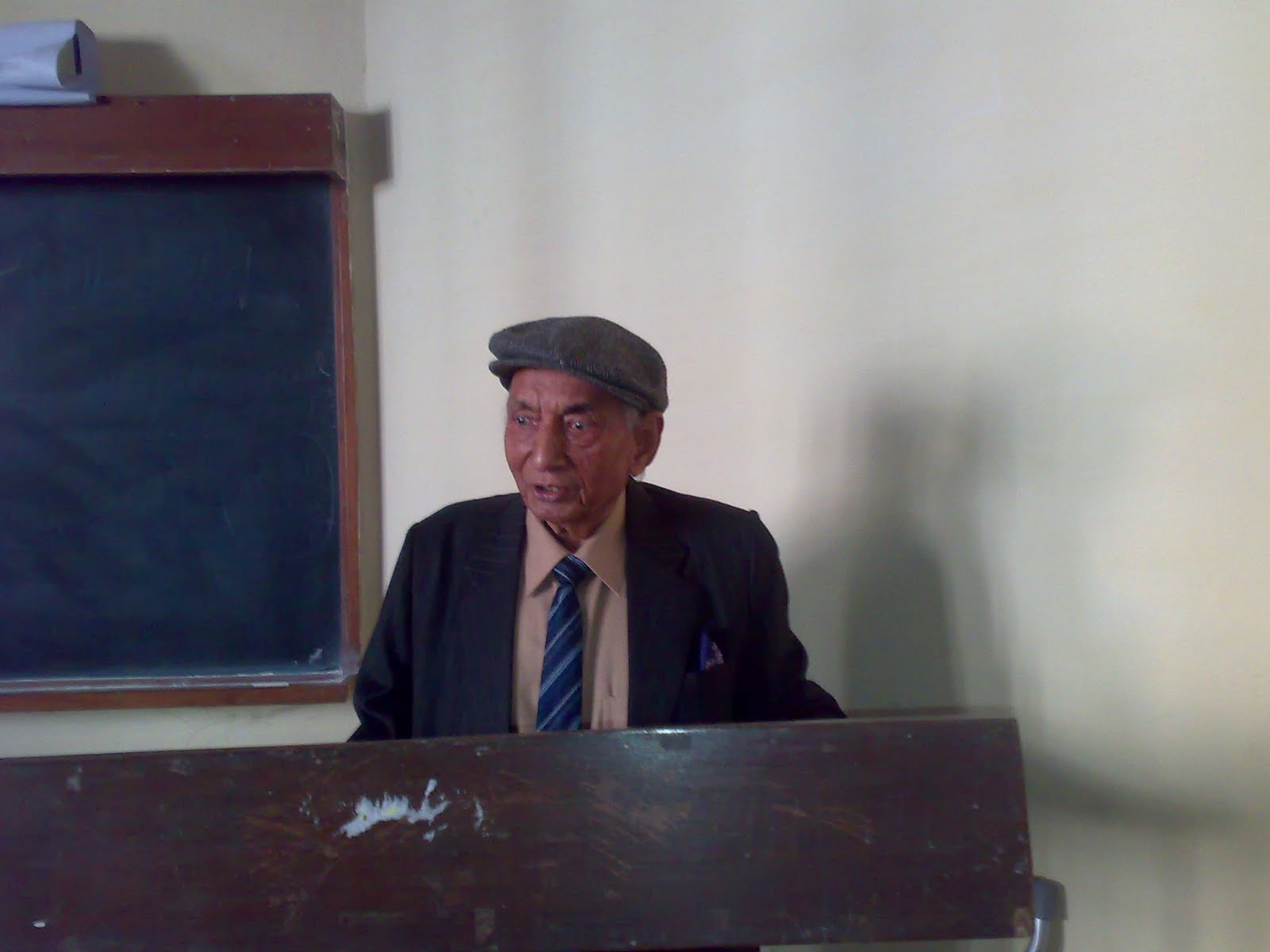
Addressing the participants which included seventy undergraduate students from Dev Samaj College for women, Ferozepur City, Dr. Dharmendra Goel, Professor Emeritus of Philosophy Department said, “Resistance is an indispensable part of democracy. Resistance is a dialogue, a fundamental right of expression which sustains the very notion of democracy. It is absolutely necessary to submit resistance if there is any violation on part of any individual or institution against the laws and the essential norms of democracy. Gandhi’s Civil disobedience or Satygraha without violence against the establishment, French resistance against the Nazi in the early fourties of the twentieth century are classic examples of the resistance.”
Professor Shalina Mehta from Anthropology Department, Panjab University, focused on tribal issues and democracy. She said that Indian society is not a homogenous society and the issues of development of the urban and the tribal are different. She said that the issues of tribal do not get proper government attention and the people who work for tribal rights face the highhandedness of the government and its officials on different fronts.
Lallan Singh Baghel of Philosophy Department, Panjab University, philosophically elaborated the notions of resistance and democracy. He said that resistance is a concept which aims at bringing real problems of the society to the attention of the government and demands its immediate solution.
Rajeev Godara from Sampooran Kranti Manch, Haryana, speaking on the Role of resistance in democracy said that Dr. Binayak Sens' arrest is a big jolt to the law and democracy of India He further said that Binayak Sen is a world acclaimed human rights worker who dedicated his entire life to work for the underprivileged in the country and his resistance to the governments' unfair policies for the tribals has cost him life imprisonment. Rajeev emphasized a need to build an atmosphere where the government should be accountable to public views and resistance against its policies, laws and other issues of development.
On the second day of seminar, Dr. Prem Singh from Delhi University talked about the nature of democracy and nature of peoples' movements. He based his lecture on the main theme of decentralization of the government and maintained that all the movements working in favour of democratic ideals have to come together to minimize the loss, the movements are suffering due to the contradictions which favors the oppressive regimes.
All the lectures were followed by serious discussions during which the students raised some intriguing questions with respect to the current nature of Indian state and its democratic profile. The seminar was coordinated by Dr. Ambuj Sharma, Asst. Professor Dev Samaj College for Women, Ferozepur and coordinator of the Critique Ferozepur.

Friday, January 28, 2011

Human Rights in India (20th January, 2011)


Ambuj Sharma of Critique Ferozepur Chapter and Philosophical Society participated and presented a paper on 'Dilemmas of Human Rights and Honour Killings In India: Unmasking the concept of Honour' in the UGC-sponsored one day National Seminar on the topic ‘Human Rights in India” organized by Department of Political Science, D. A. V. College, Abohar, Punjab on 20th January, 2011 at D. A. V. College Abohar. In a short presentation Ambuj critiqued the notion of ‘honour’ giving an account of the evolution of morality. He strongly urged the participants to take a course on reflective Morality while drawing moral judgments. He said that largely people follow the notions of customary and instinctive morality and closes all doors to reflective and critical thinking. He further said that to take a life of an individual who decides to marry an individual of his or her own choice is the greatest violation of any values in ethics or religion. He asked the participants to draw another sketch of morality with reason and respect to human life and dignity.
Ambuj was highly benefited from the suggestions and comments from his friends Mr. Paras Aggarwal from Department of Physics and Mr. Kashmiri Lal from Department of Hindi D. A.V. College, Abohar.
Among other prominent speaker who addressed the seminar were Prof. Ronki Ram, Chairman, Dept. of Political Science, Panjab University, Prof. Rajiv Lochan, Chairman, Dept of History, Prof. I. D. Gaur, Dept of History, Lallan Singh Baghel, Dept of Philosophy, Dr. Vijay Nagpal, Dept of Laws, Panjab University, Joginder Singh, Former Director, C.B.I.
Dr. Vandana Munjal, Head, Department of Political Science, D. A.V. College, Abohar who was the convener of the seminar, along with her other colleagues, students and staff left no stone unturned to provide great hospitality and comfort to the participants during their entire stay at the college.

Monday, December 27, 2010

Life Imprisonment to Binayak Sen: Violation of Human Dignity and Human Rights"


Critique Ferozepur Chapter and Philosophical Society: A Students Discussion Forum and other students of the Dev Samaj College for Women, Ferozepur City, Punjab expressed their dissatisfaction over the recent verdict of life imprisonment by the sessions court of Raipur to Dr. Binayak Sen. They said that the judgment is as a big jolt to democracy and human rights in India. In the discussion on “Life Imprisonment to Binayak Sen: Violation of Human Dignity and Human Rights” presided by the college principal Dr. Mrs. Madhu Prashar, Sukhdeep Kaur , President of Philosophical Society, Karamjeet Kaur , Amandeep Kaur, Amrit Kaur, and Komalpreet shared their views with the students and faculty of the campus.
In the first round of discussion Amandeep said that Binayak Sen worked on Mahatma Gandhi’s principles and extensively worked for the underprivileged section of our society. Raipur Sessions Court passed a judgement against a man who left the privileged life in which he was born and raised and devoted his life for social service. The cases should again be scrutinized considering his previous records and service to society.
Karamjeet said that Dr Sen has been contributing theoretical papers to books and journals on public health. He was honored with the Paul Harrison award in 2004 for lifetime work of medical care in the service of humanity. She was of an opinion that there are very few doctors in the country, who practiced among the poor and the disadvantaged of the country, Dr. Binayak was one such man. She further said that the current verdict is against the principles of law and democracy. Komalpreet said that putting Binayak Sen behind bars is the death of democracy and human rights in India.
On the occasion college Principal Dr. Madhu Prashar, faculty members and students of the college appealed the central government, the Supreme Court and High Court of Chattisgarh to re-look on the matter and pursue a fresh enquiry as they are sure that Dr. Binayak Sen is innocent.

Wednesday, November 24, 2010

Modernity, Development and Violence: Gandhi’s Perspective (12- 13 November, 2010)


Ambuj Sharma of Philosophical Society participated and presented a paper on Modernity, Development and Violence: Gandhian Perspective in the UGC National Seminar On ‘Science, Society and Liberty’ organized by Government Meera Girls College and Mohanlal Sukhadia University, Udaipur at Udaipur on 12-13 November, 2010
In his paper he tried to bring the debates of Gandhian critique of technology and its various forms. He argued the concept of development associated with the advancement of technology and globalization. He brought the Philosophical critique of western modernity offered by Gandhi and said that “technology is acting as a new slavery of commodities and market which Gandhi opposed. He argued that in the era of science and technology it is important to understand the politics behind technology as to who are benefited largely by the technology and who is deciding the course of technology. The paper tried to reflect on the Gandhian approach to understand society and its development.